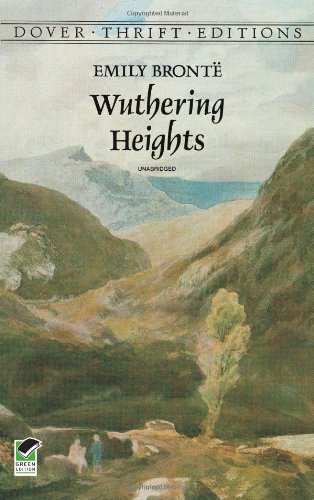
You are driving, it is cold and pouring rain. Bam, your car breaks down. You see a mansion uphill and you decide to go inside to ask to borrow a phone. You are greeted by an odd and grumpy group of people. Despite the odd first impression, you come to find out that there is a dramatic history with as to why the family ended up the way it did. This is a scene that occurs in many novels and movies. Where did it all originate from? Well I have an answer for it and to put it simple terms let’s just say Wuthering Heights. This epic gothic novel served as a catalyst for other gothic novels and/or films to come. If you would like a little more insight on the novel, watch the video on 10 things you need to know about Wuthering Heights below:
This work of literary merit was written by Emily Bronte, who published it under the pseudonym Ellis Bell. Bronte was one of six children, which also included famous author Charlotte Bronte. Emily was mostly home schooled and found the inspiration to write through reading other great works. Not much time passed before Emily and Charlotte Bronte began publishing poems under pen names. Unfortunately this amazing author only wrote this one novel as she tragically died shortly after its release.
Why did I just give you a history lesson on this author’s life? Well, the life portrayed in Wuthering Heights mirrors her own. The Yorkshire moors of northern England reflects the country and secluded lifestyle the Bronte sisters were accustomed to growing up. Bronte was huge on two distinctly opposite things mirroring each other almost identically. For instance, the weather occurring on the two properties (Wuthering Heights and Thrushcross Grange) represented the attitudes of its inhabitants. Wuthering Heights, which is located on a hill, was prone to getting terrible weather which included rain, and terrible storms. This horrible weather reflected on the attitude of Heathcliff in particular, who was always on edge seeking revenge because he could not live his life with his love, Catherine. In contrast, Thrushcross Grange is located in a valley where it is always calm, and sunny. This beautiful weather reflected the attitudes of the Lintons and how they were civilized people.
This novel contains a plethora of elements that I wish I could talk about, but this blog post would become a novel within itself, so I will simply talk about why this novel is a work of literary merit in my eyes. Bronte excellent portrayed the complexities of life and how generations serves as catalyst for those in the future. Birth, life, death, love, hatred, and death are some of the few topics touched upon in a few hundred pages. I really did not know what to expect when I first heard that my class was reading the book, but I am glad that I have this novel under my belt because I learned so much from reading Bronte’s marvelous words. So next time you see a movie where there is a creepy house and someone is led to it because of stormy weather, just know that it came from Wuthering Heights.

After reading your blog post, now I am wondering if there are any work that mirrors the life of the author. Also, this prompt me to think about the source of the authors' inspiration, in which where do the authors come up with the characters' names or the plot? On the other hand, I agree with you that this novel is a work of literary merit due to its sophisticated vocabulary and the chronological order of the plot. In connection to Kendall's blog post, the characterizations within the work can be related to different types of people the audience meet on a daily basis. Therefore, this work can withstand the test of time, an important element of a work of literary merit. I am looking forward to read your next blog post!
ReplyDeleteYour post reminds me of the video from Discovery Education! It was a nice sort of wrap of the video and brought everything together nicely! When I watched the video, I immediately gravitated towards the idea that Emily Brontë used her own experiences to develop her characters and the plot of her novel...although some of her writing was quite imaginative. Perhaps the most perplexing parallel between her life and the novel was the similarity between her death and Heathcliff's death. I thought it was rather crazy that in writing about Heathcliff's death she mirrored her own before it even happened. They both fell ill and refused to seek medical attention. Also, I began thinking about what Cheuk-Lam did when I read you blog post and watched that video. Usually, when I read, I remind myself that literature is a form of art and expression-an extension of the creator. So much if the writing is wrapped up experiences and what better experience to reference than their own? It kind of allows for each artist to leave their finger print upon every thing they create even if they address the same ideas as another artist. Great post!
ReplyDelete