Wednesday, April 6, 2016

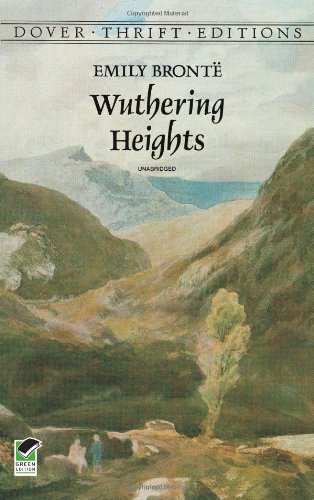
Wuthering Heights Rewind


You are driving, it is cold and pouring rain. Bam, your car breaks down. You see a mansion uphill and you decide to go inside to ask to borrow a phone. You are greeted by an odd and grumpy group of people. Despite the odd first impression, you come to find out that there is a dramatic history with as to why the family ended up the way it did. This is a scene that occurs in many novels and movies. Where did it all originate from? Well I have an answer for it and to put it simple terms let’s just say Wuthering Heights. This epic gothic novel served as a catalyst for other gothic novels and/or films to come. If you would like a little more insight on the novel, watch the video on 10 things you need to know about Wuthering Heights below:


This work of literary merit was written by Emily Bronte, who published it under the pseudonym Ellis Bell. Bronte was one of six children, which also included famous author Charlotte Bronte. Emily was mostly home schooled and found the inspiration to write through reading other great works. Not much time passed before Emily and Charlotte Bronte began publishing poems under pen names. Unfortunately this amazing author only wrote this one novel as she tragically died shortly after its release.

Why did I just give you a history lesson on this author’s life? Well, the life portrayed in Wuthering Heights mirrors her own. The Yorkshire moors of northern England reflects the country and secluded lifestyle the Bronte sisters were accustomed to growing up. Bronte was huge on two distinctly opposite things mirroring each other almost identically. For instance, the weather occurring on the two properties (Wuthering Heights and Thrushcross Grange) represented the attitudes of its inhabitants. Wuthering Heights, which is located on a hill, was prone to getting terrible weather which included rain, and terrible storms. This horrible weather reflected on the attitude of Heathcliff in particular, who was always on edge seeking revenge because he could not live his life with his love, Catherine. In contrast, Thrushcross Grange is located in a valley where it is always calm, and sunny. This beautiful weather reflected the attitudes of the Lintons and how they were civilized people.

This novel contains a plethora of elements that I wish I could talk about, but this blog post would become a novel within itself, so I will simply talk about why this novel is a work of literary merit in my eyes. Bronte excellent portrayed the complexities of life and how generations serves as catalyst for those in the future. Birth, life, death, love, hatred, and death are some of the few topics touched upon in a few hundred pages. I really did not know what to expect when I first heard that my class was reading the book, but I am glad that I have this novel under my belt because I learned so much from reading Bronte’s marvelous words. So next time you see a movie where there is a creepy house and someone is led to it because of stormy weather, just know that it came from Wuthering Heights.


Thursday, March 3, 2016

Base Details- Reading Between the Lines

Base Details
If I were fierce, and bald, and short of breath,
I’d live with scarlet Majors at the Base,
And speed glum heroes up the line to death.
You’d see me with my puffy petulant face,
Guzzling and gulping in the best hotel,
Reading the Roll of Honour. ‘Poor young chap,’
I’d say—‘I used to know his father well.
Yes, we’ve lost heavily in this last scrap.’
And when the war is done and youth stone dead,
I’d toddle safely home and die — in bed.
In my AP Literature and Composition Class, we have been heavily studying poetry.  More often than not, after reading a poem I am left scratching my head wondering what I just read-- which is exactly what happened after I read Siegfried Sassoon’s Base Details. But as human beings do, I decided to climb that huge mountain of poetry and in the end I think I conquered it. It’s not as though I am some type of expert or something but, I took this challenge whole-heartedly.
First and foremost it is important to point out that this poem is a war poem, which means that the Sassoon will either criticise war in a positive or negative way. One literary element that is heavily used throughout the poem is excellent use of imagery. The very first line of the poem reads: “If I were fierce, and bald, and short of breathe…(1). This first line really made me think, the speaker obviously put himself in the shoes of someone who had these qualities, but then I asked myself, “Why these specific qualities?” As I continued to go through the rest of the poem, the reasons why the speaker would want to possess these qualities. The next line was one that did confuse me when the speaker said that they would live with “scarlet Majors at the Base” (2). I tried to research the word scarlet but all I got was: of the color scarlet and grossly and glaringly offensive. The conclusion I came to about line 2 is that the speaker would literally “live with scarlet Majors at the Base” (2). Meaning that the Majors are safe and sound at the base camp all whilst the soldiers are out fighting with their lives on the line. Maybe being fierce, bald, and short of breathe came with the fact that he/she would have some sort of control or authority over the soldiers at their base. Maybe that is the reason why the speaker would have any desire to possess such qualities. In line 5 the speaker says that he/she would “[guzzle] and [gulp] in the best hotel”-- an image of a bar, a fancy bar, immediately entered my head. Which again pointed out the fact that the Majors of the Base are having plenty of time to relax and let loose, while the rest of the soldiers are again, risking their lives for their country. With all of this the Majors of the Base are also sending “glum heroes up the line of death” (3)-- this haunting image sent chills up my spine. The mere fact that the Majors of the Base are having a great time at a fancy bar while soldiers are literally lining up to face their deaths on the battlefield. Not a very pretty image is it?
Noticing this use of visual imagery I could not help but get a feeling that there was something bigger going on here-- that there was a bigger message hiding behind all of this. In my opinion, I think that Sassoon is criticizing those of higher power in the military and how they sort of hide behind the soldiers who actually fight in combat. I mean at the end of the day the Majors of the Base are “[toddling] safely home and die-- in bed” (10). Unlike those who sacrifice their lives for their country and sometimes die in the cold, in a sea full of hatred.